
It can give you a clear answer in seconds.
It can explain an unfamiliar term, write a message, suggest a headline, shorten text or generate a list of ideas.
But if you use ChatGPT only by asking one question, taking the first answer and closing the conversation, you are using only a small part of its capabilities.
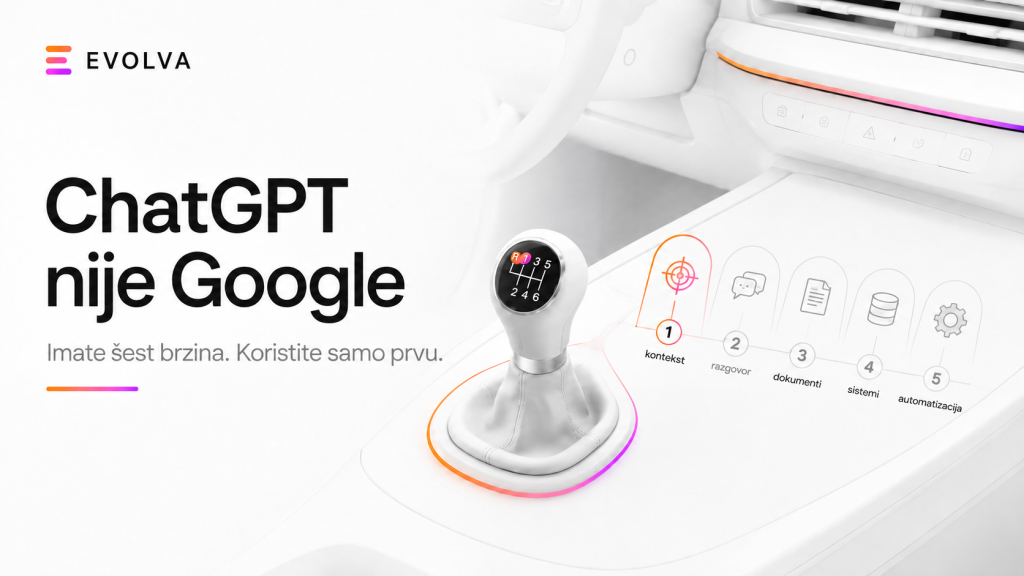
It is like having a car with six gears, navigation and driving-assistance systems — but always driving in first gear.
The car moves. You will get somewhere. But you are not using what it was built for.
The same happens when we use ChatGPT only as a substitute for a traditional web search.
ChatGPT is more than a search engine
When you use Google or another search engine, you usually look for pages that might contain the answer. You get a list of results, open pages, compare information and decide what to do with it. ChatGPT can also help find current information online, but its real value goes beyond finding answers. You can give it:- the goal you want to achieve;
- the context of your situation;
- documents and materials;
- rules it must follow;
- criteria for evaluating the result;
- the style in which it should communicate;
- feedback on the previous version.
First gear: one question and one answer
Using ChatGPT in “first gear” usually looks like this: “Write me an Instagram post.” ChatGPT will write something. The answer may be grammatically correct and look quite decent at first glance. However, the system does not know:- what you do;
- who you are addressing;
- what you sell;
- your brand’s tone;
- the goal of the post;
- the response you expect;
- what you have already published;
- which expressions you don’t want to use.
Second gear: give it context
Instead of a short request: “Write me an Instagram post.” you can write: “I run an educational brand that helps entrepreneurs, employees and beginners use AI and digital tools in practice. I need an Instagram post explaining why using ChatGPT only for individual questions is not enough. The tone should be professional, warm and simple, without technology hype. The goal is for readers to recognize that they are using only a small part of the tool’s capabilities and want to learn more.” ChatGPT no longer has to guess everything that matters. It has received:- the brand’s positioning;
- the target audience;
- the topic;
- the communication tone;
- the intended effect of the post.
Third gear: don’t treat the first answer as final
ChatGPT is not a machine where you enter one command and receive a perfect finished product. The first answer is usually just the first version. You can continue the conversation: “The introduction is too general. Start with the metaphor of a car being driven only in first gear.” Then: “Shorten the second section and add a specific example for a small business.” Then: “The ending should not be aggressively sales-focused. Invite readers to assess how they currently use ChatGPT.” This does not mean the initial prompt failed. It is a normal process of developing the result. The major difference between beginner and more advanced ChatGPT use is often not who knows a more complicated command. It is who knows how to:- evaluate the answer received;
- explain what is wrong;
- request a precise change;
- guide the conversation toward their goal.
Fourth gear: work with your own materials
ChatGPT can work with documents, spreadsheets, presentations and other supported files. For example, you can send it a document and ask it to:- extract the key information;
- compare two versions;
- identify recurring themes;
- reorganize the content;
- adapt the text for a specific audience;
- apply a given framework to existing material;
- prepare a new version based on your data.
- a description of your services;
- a previous proposal;
- meeting notes;
- information about the prospective client;
- a price list;
- business communication guidelines.
Fifth gear: turn repetition into a system
The greatest value comes when you stop solving the same problem from scratch every time. Imagine that every week you need to prepare:- a blog article;
- a Facebook post;
- Instagram content;
- newsletter;
- a sales call to action.
- the target audience;
- brand positioning;
- the communication tone;
- writing guidelines;
- the article structure;
- how topics are selected;
- required elements;
- SEO information;
- the type of call to action;
- how one piece of content is repurposed into multiple formats.
From a quick answer to an AI collaborator
We can think of ChatGPT use in five levels.1. Question
You ask for one piece of information. Example: “What is a newsletter?”2. Task
You request a specific result. Example: “Write an introduction for a newsletter.”3. Conversation
You give feedback and develop the result. Example: “The introduction is too formal. Shorten it and adapt it for small-business owners.”4. Context
You add your own materials, goals, rules and previous decisions. Example: “Use my brand description, the previous three newsletters and the communication guidelines in the attached document.”5. System
You turn a recurring task into a standardized process. Example: “Based on the approved weekly topic, prepare a blog, newsletter, Facebook post and three Instagram suggestions according to our Content Engine guidelines.” Most users stay at the first two levels. The greatest time savings and best results usually come when you start using context and repeatable systems.A simple framework for working better with ChatGPT
Before sending your next request, check whether you have included these five elements.1. Context
Who are you, what do you do and why do you need this task?2. Goal
What should happen after the result is used?3. Task
What exactly should ChatGPT write, analyze, organize or suggest?4. Criteria
What tone, length, format, limitations and required elements must be respected?5. Next step
Do you want questions, analysis, a first draft or a final deliverable? Example: “I run a small salon and want to reduce repeated client questions. I will send you a list of the messages we receive most often. Analyze the messages, group the questions by topic and suggest a structure for an answer database. Do not write the final answers yet. First show me the categories and explain the grouping logic.” You are not merely asking for text. You are asking for part of a specific business process.EVOLVA INSIGHT
A good prompt is not the longest possible instruction. A good prompt provides enough context for the system to understand the goal, while leaving room for checking, discussion and improving the result.Can ChatGPT replace Google?
Not completely — and that is not the real goal. When you want to find a specific website, check an original document, compare sources or obtain official information, web search still has an important role. ChatGPT can help search for and explain information. Its additional value is that it can keep working with that information:- summarize it;
- compare it;
- adapt it to your situation;
- turn it into a plan;
- draft a document;
- develop the result through conversation.
Does every prompt need to be long?
No. A short, clear request is enough for a simple task. More context is needed when the task is:- specific;
- important to the business;
- connected to your rules;
- intended for a specific audience;
- based on your documents and previous decisions.
Do I have to be an AI expert?
No. You need to know:- what you want to achieve;
- what a good result looks like;
- what needs to change in the answer;
- which information needs to be checked.
Don’t stay in first gear
ChatGPT can answer a question. But it can also:- analyze your materials;
- follow defined rules;
- develop an idea through conversation;
- adapt content for different audiences;
- help organize recurring tasks;
- become part of a clear system of work.
Want to use ChatGPT as a system, rather than just a place for quick answers?
Explore EVOLVA courses and practical programs, and learn to turn your tasks, knowledge and processes into a clear way of working. Learn to use AI more effectivelyLorem ipsum dolor sit amet, consectetur adipiscing elit. Ut elit tellus, luctus nec ullamcorper mattis, pulvinar dapibus leo.