
You always feel as though you need just a few more hours in the day.
That you could get everything done if the day were longer.
That you would be more organized without so many interruptions.
That you could finally put everything in order once this busy period is over.
But the busy period usually never ends.
Only the tasks, clients, messages and deadlines change.
And every morning you are still trying to remember:
- what you need to do first;
- who you haven’t replied to;
- where the document you need is;
- how you solved the same problem last time;
- what you promised the client;
- what the next step is.
Perhaps you really do need more time.
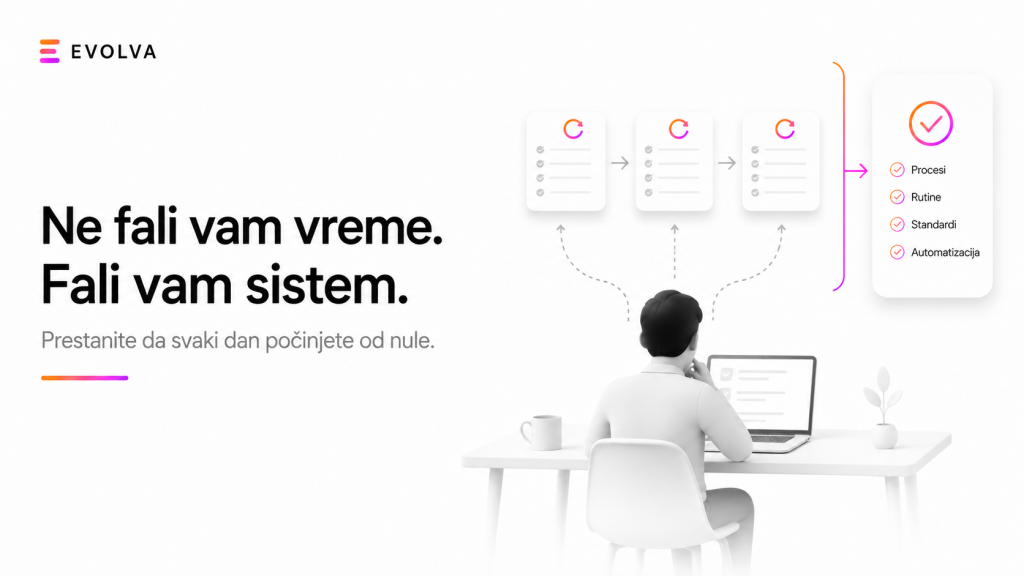
But very often, you need a system even more — one that stops you from starting from scratch every day.
Not every shortage of time is a time problem
When we say we don’t have time, we usually mean we have too many responsibilities.
Yet much of the day is not spent on doing the work itself.
It goes on everything between tasks:
- searching for information;
- remembering what needs to be done;
- making the same decision again;
- writing the same message;
- explaining the same procedure;
- opening ten apps;
- switching between tasks;
- fixing mistakes caused by rushing;
- checking whether something has been done.
Five minutes here, ten minutes there.
Individually, it doesn’t look serious.
But when those interruptions and repetitions add up, they become hours of invisible work.
So the problem is not always:
“I have too much work.”
Sometimes the real problem is:
“I haven’t defined how this work gets done.”
What working without a system looks like
Working without a system does not necessarily look chaotic from the outside.
You may have a tidy desk, calendar, planner and several productivity apps.
Yet still start from scratch every day.
This usually shows up in a few patterns.
You rewrite the same messages
Clients ask similar questions.
You open a new message each time and compose the reply again.
You don’t want to sound robotic, so you avoid identical messages. That is fine.
But without a basic template, every reply requires another decision, new wording and extra time.
You save documents but can’t find them
The document exists.
You just don’t know whether it is:
- on your computer;
- in Google Drive;
- in an email attachment;
- in a WhatsApp conversation;
- in a folder named “New”;
- in the “Final” folder;
- or in “Final latest”.
The problem is not the missing document.
The problem is that there is no agreed location or filing rule.
You keep tasks in your head
While working on one thing, you think about five more.
You remember something while cooking, driving or trying to fall asleep.
Then you tell yourself:
“I’ll remember.”
Sometimes you do.
Sometimes you don’t.
But even when you do, your brain stays busy holding on to unfinished tasks.
That creates the feeling that your working day is never truly over.
You start every piece of content with a blank page
You need to write a post, proposal, email or article.
You open a blank document and think again:
- how should I start;
- what information should I include;
- in what order;
- how should I finish;
- what call to action should I add.
A blank page consumes more energy than we think.
Not because you can’t write, but because you reinvent the structure every time.
A system does not mean complicated technology
When people hear “system”, they often imagine:
- complicated software;
- expensive automation;
- ten connected apps;
- a large team;
- technical knowledge;
- endless configuration.
But a system can be very simple.
A system is a predefined answer to the question:
“How do we do this next time?”
It can be:
- one clearly named folder;
- an email template;
- a list of steps;
- a form the client completes;
- a document-naming rule;
- one task overview;
- a prepared article structure;
- a library of common answers;
- a repeatable process for onboarding a new client.
A good system does not complicate work.
It removes decisions you no longer need to make every time.
Step one: save what repeats
Before automation and new tools, you need to identify what you already do repeatedly.
Over a few days, pay attention to tasks that make you think:
- “The same thing again.”
- “Where did I put that?”
- “How did I do this last time?”
- “I have to explain everything again.”
- “I can’t remember right now.”
- “I know I already have this information.”
These are signs that there is room for a system.
What to save
Save:
- answers to frequently asked questions;
- messages you write repeatedly;
- proposal structures;
- process steps;
- links you send often;
- documents you use often;
- communication guidelines;
- the information you request from clients;
- ideas that can be reused;
- final checks before sending or publishing.
You don’t need to build a perfect knowledge base immediately.
Just stop leaving important things scattered across messages, notes and your own memory.
Step two: standardize the process
Once you save what repeats, the next question is:
“What is the best sequence of steps?”
Suppose you are onboarding a new client.
Without a system, the process might look like this:
- the client sends information through messages;
- you ask for missing information afterwards;
- access details arrive through different channels;
- deadlines are not clearly recorded;
- the client asks what comes next;
- you check your notes;
- a step gets skipped;
- you end up fixing everything as you go.
A standardized process can include:
- an introductory questionnaire;
- a list of required access permissions;
- an initial review;
- goal setting;
- a work plan;
- an implementation checklist;
- a final report.
The workload has not magically disappeared.
But you no longer have to invent how to do it every time.
Step three: create templates
A template is not finished text you copy blindly.
A template is a structure that prevents you from starting with a blank page.
You can create a template for:
- a proposal;
- a blog article;
- an email to a client;
- a monthly report;
- a social media post;
- a meeting;
- handling a new inquiry;
- resolving a complaint;
- preparing a campaign;
- publishing content.
A good template contains fixed elements while leaving room for the specific case.
For example, a business proposal template may include:
- the problem the client wants to solve;
- the goal of the collaboration;
- the proposed scope of work;
- implementation phases;
- deadlines;
- the price;
- both parties’ responsibilities;
- the next step.
You don’t copy the same proposal for every client.
But you stop forgetting important parts or changing the structure unnecessarily.
Step four: only now consider automation
Automation does not fix a bad process.
It only speeds it up.
If the process is unclear, you will automate:
- the wrong steps;
- unnecessary messages;
- chaotic data;
- poorly defined tasks;
- mistakes that will now recur faster.
That is why the order matters.
First, the process
What exactly do we do?
Then, the rule
What triggers the step, and who is responsible?
Next, the template
What information and format do we use?
Only then, automation
Which part can a tool handle?
We don’t automate chaos. We build a system first.
Where AI can help
AI is not a substitute for a process you have not yet defined.
But it can be an excellent assistant when it knows:
- the goal;
- the steps;
- the rules it needs to follow;
- the data it uses;
- what a good result looks like.
For example, AI can help you:
- turn recurring messages into a response library;
- extract process steps from notes;
- create a first draft of a checklist;
- turn one approved article into a Facebook post;
- analyze common client questions;
- draft a proposal using a template;
- organize a document into clear categories;
- turn one topic into multiple content formats.
But you need to define what the system should do first.
AI can help with driving.
It cannot decide where you want to go.
A system does not need to be perfect from the start
One of the greatest barriers to organization is the idea that everything must be perfectly set up.
It doesn’t.
The first version of a system can be:
- one Google Drive folder;
- one document with common answers;
- one weekly checklist;
- one post template;
- one file-saving rule;
- one list of steps for a recurring task.
A system needs to be useful first.
Only later does it need to become more polished, detailed and automated.
It is better to have a simple system you use than a perfect system you never finish.
How to identify what to systematize first today
Choose one task that:
- you do at least once a week;
- takes more time than it should;
- involves the same steps;
- often requires searching for information;
- depends on you remembering something;
- could cause an error if you skip a step.
Then answer five questions.
1. What triggers this task?
Does it start with an inquiry, payment, document, message or a particular date?
2. What information is needed?
What must you have before you begin?
3. What steps are required?
What is always done, and in what order?
4. What does a completed task look like?
What result confirms that the work is done?
5. What can be reused?
Which answer, document, template or part of the process will you not need to create from scratch next time?
Simply answering these questions is the start of a system.
EVOLVA INSIGHT
A good system is not the one with the most tools.
A good system reduces the number of things you need to remember, repeat and decide again every time.
Productivity does not start with the question:
“How can I work faster?”
It starts with the question:
“What no longer needs to be done from scratch?”
You don’t need another to-do list
A to-do list can tell you what to do.
But it often does not tell you:
- how the task is done;
- where the information is;
- what the next step is;
- what needs to be checked;
- what the finished result looks like;
- what should be saved for next time.
That is why you can have a long, tidy list and still feel lost.
A task list is not the same as a system of work.
A system connects the task with information, rules, materials and a clear outcome.
Working faster is not the only way to save time
We often try to be faster.
Reply faster.
Write faster.
Switch between tasks faster.
But the greatest time savings don’t always come from speed.
They come from:
- no longer searching for what you have already created;
- no longer writing the same thing from scratch;
- not relying only on memory;
- not skipping important steps;
- not making the same decision ten times;
- not repeatedly fixing the same mistakes.
A system does not give you more hours in the day.
It gives you more useful time within the hours you already have.
Stop starting from scratch every day
You may not be able to reduce all your responsibilities.
But you can reduce the number of things you reinvent each time.
Start with one process.
Save what repeats.
Define the steps.
Create a template.
Test it.
Only then decide what can be automated.
You don’t have to build a large business system immediately.
It is enough not to start tomorrow’s working day completely from scratch.
Want a clearer way of working, less repetition and more time for important tasks?
EVOLVA helps you identify where you lose time, organize recurring processes and turn them into a simpler way of working with digital tools and AI.
Find a solution for the way you work
Lorem ipsum dolor sit amet, consectetur adipiscing elit. Ut elit tellus, luctus nec ullamcorper mattis, pulvinar dapibus leo.
Lorem ipsum dolor sit amet, consectetur adipiscing elit. Ut elit tellus, luctus nec ullamcorper mattis, pulvinar dapibus leo.